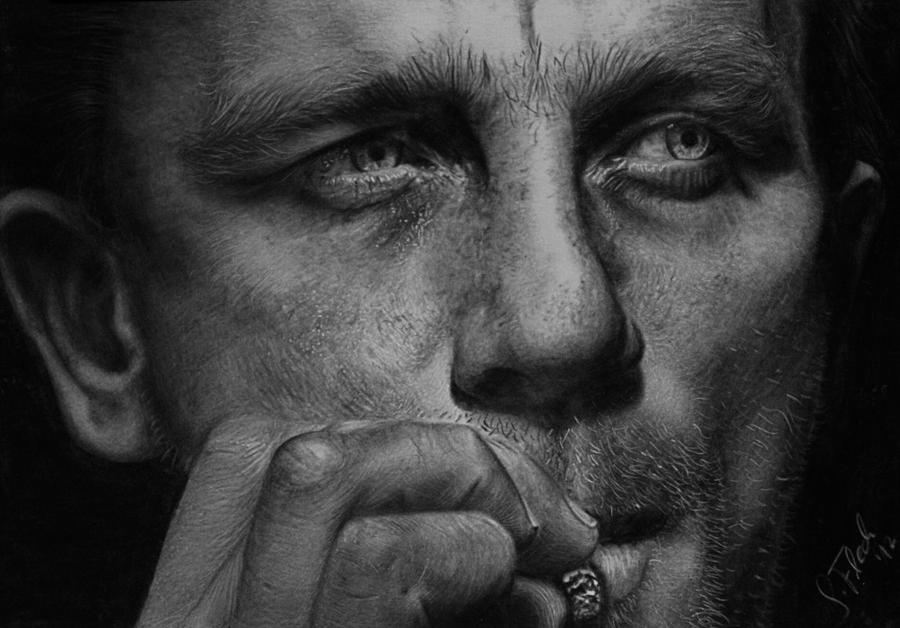
"Hyperrealism is a genre of painting and sculpture resembling a high-resolution photograph."

The early 21st Century Hyperrealism was founded on the aesthetic principles of Photorealism. American painter Denis Peterson, whose pioneering works are universally viewed as an offshot of Photorealism, first used "Hyperrealism" to apply to the new movement and its splinter group of artists.
However, Hyperrealism is contrasted with the literal approach found in traditional photorealist paintings of the late 20th Century. Hyperrealist painters and sculptors use photographic images as a reference source from which to create a more definitive and detailed rendering, one that often, unlike Photorealism, is narrative and emotive in its depictions.
However, Hyperrealism is contrasted with the literal approach found in traditional photorealist paintings of the late 20th Century. Hyperrealist painters and sculptors use photographic images as a reference source from which to create a more definitive and detailed rendering, one that often, unlike Photorealism, is narrative and emotive in its depictions.

Hyperrealism, although photographic in essence, often entails a softer, much more complex focus on the subject depicted, presenting it as a living, tangible object. These objects and scenes in Hyperrealism paintings and sculptures are meticulously detailed to create the illusion of a reality not seen in the original photo. This is not to say they're surreal, as the illusion is a convincing depiction of (simulated) reality. Textures, surfaces, lighting effects, and shadows appear clearer and more distinct than the reference photo or even the actual subject itself.

Subject matter ranges from portraits, figurative art, still life, landscpaes, cityscapes and narrative scenes. The more recent hyperrealist style is much more literal than Photorealism as to exact pictorial detail with an emphasis on social, cultural or political themes.

Hyperreal paintings and sculptures further create a tangible solidity and physical presence through subtle lighting and shading effects. Shapes, forms and areas closest to the forefront of the image visually appear beyond the frontal plane of the canvas, and in the case of sculptures, details have more clarity than in nature. Hyperrealistic images are typically 10 to 20 times the size of the original photographic reference source, yet retain an extremely high resolution in colour, precision and detail. Many of the painting are achieved with an airbrush, using acrylics, oils or a combination of both.